Showing posts with label autumn. Show all posts

Tuesday, October 20, 2009

Autumn in my Heart


leaf-flames lighting the air,
pirouetting wildly in the gentle winds.
the heart filled with music,strumming the notes of nature,
the mind dances in crimson silk, wearing crowns of silver-frost
the body sways, to the rhythms of the autumn raaga…

. . .

Friday, September 12, 2008

Mahalaya: Morning Chants


Mahalaya is an auspicious occasion observed seven days before the Durga Puja, and heralds the advent of Durga, the goddess of supreme power. Mahalaya ushers in the aura of Durga Puja. It's a kind of invocation or invitation to the mother goddess to descend on earth – ‘Jago Tumi Jago’. This is done through the chanting of mantras and singing devotional songs. The midnight chants of various hymns of Mahishasura Mardini remind one of the beginnings of Durga Puja.

The countdown for the Durga Puja begins much earlier; it is only from the day of Mahalaya that the preparations for the Puja reach the final stage. What has become an indispensable part of Mahalaya is an early morning radio program. The enchanting voice of Birendra Krishna Bhadra fill up the predawn hours of the day thus marking the beginning of ‘devipaksha’ and the beginning of the count-down to Durga Puja.


Autumn in its bloom, mingled with the festive spirit of Durga Puja reaches its pitch on the day of Mahalaya. The time has arrived for the mother to come, for the people to meet their beloved ones and to worship the Power and the glory of stree shakti (women power) as the devipaksha takes over pitripaksha for the time onwards.


On this day Bengali's visits the River Ganges or other rivers. The dark fortnight of amavashya is known as the mahalaya paksha or the fortnight especially sacred for offering oblations to the departed ancestors. The day of Mahalaya is also the day of remembrance. Thousands of people gather at the rivers early in the morning to offer tarpan in memory of their forefathers.


The banks of rivers become a sea of humanity. Priests are seen busy performing tarpan for devotees in groups. The rituals start from early dawn and end during the midday. Devotees and worshipers buy clothes and sweets to offer to their forefathers. Tarpan is to be performed in empty stomach and after offering tarpan, people eat at the same place.


Since the early 1930s, Mahalaya has come to associate itself with an early morning radio program called mahisasura mardini’ or 'The Annihilation of the Demon.' This All India Radio (AIR) program is a beautiful audio montage of recitation from the scriptural verses of chandi kavya', Bengali devotional songs, classical music and a dash of acoustic melodrama.

This program has almost become synonymous with Mahalaya. For nearly six decades now, the whole of Bengal rises up in the chilly pre dawn hours, 4 am to be precise, of the Mahalaya day to tune in to the mahisasura mardini broadcast.

One man, who'll always be remembered for making Mahalaya memorable to one and all, is Birendra Krishna Bhadra, the magical voice behind the mahisasura mardini. The legendary narrator recites the holy verses and tells the story of the descent of Durga to earth, in his inimitable style. Bhadra has long passed away, but his recorded voice still forms the core of the Mahalaya program.

In a sonorous, reverberating voice Birendra Bhadra renders the Mahalaya recital for two thrilling hours, mesmerizing every household with the divine aura of his narration, as the Bengalis submerge their souls in quiet moments of prayer.

As the recital begins, the serene morning air resonates with the long drawn sound of the sacred conch shell, immediately followed by a chorus of invocation, melodiously setting the stage for the recitation of the 'Chandi Mantra'.


The whole world wakes up from slumber to greet the onset of Durga Puja of which Mahalaya is the first step. With Mahalaya the Bengalis get busy to complete the final preparations for their greatest festival - Durga Puja. Normally, bonus to all employees is paid latest by Mahalaya – hence, the shopping spree also gains momentum with shops displaying the latest designs, and inviting customers to participate in various gift schemes.


Mahalaya is not a myth but a concept and a tribute to the primeval source of power, the qualities of all inundated in form of one shakti, one nari, the unity of power, energy and enterprise within one soul one body. She is a manifestation of majestic might and unified strength, preeminently materialised to protect humanity and restore normalcy in the process of creation from the evil incarnates.

Ya Devi svarbhabhuteshu Saktirupena sangstitha
|| namastasyai namastasyai namastasyai namo namah ||
Ya Devi svarbhabhuteshu Matrirupena sangstitha
|| namastasyai namastasyai namastasyai namo namah ||
Ya Devi svarbhabhuteshu Santirupena sangstitha
|| namastasyai namastasyai namastasyai namo namah ||


Listen / download the 'Mahisasura Mardini' here:


. . .

Tuesday, August 12, 2008

Autumn Songs


The autumn has arrived with a charming bloomed lotus as her face, emboldening the heart-pleasing face of a new bride, and the autumnal fields of white grass with whitish flowers as her cover. The amorous clucking of swans that have just returned from the lakes, as rains have gone, are the jingling anklets of autumn.


Blanched is the earth with whitish grass and the nights with silvery coolant moonbeams of the moon, and the rivers with white swans, lakes with white-lotuses, and that forest up to its fringes with whitish jasmine flowers, the seven-leaved banana plants sagging under the weight of their flowers and now the paddy is ready to ripe with the tenuous stalks of rice with their necks a little bent down.


The wind is now wiggling the well-ripened rows of rice stalks, curvy under the weight of their cobs, and the trees sagging under the weight of their flowers, wobbling the fully bloomed clumps of lotuses in the lakes, and wriggling the hearts of young men and women, with a lilting breeze and lively freshness.


The rivers are journeying slowly with a strutting of prideful lovely girls, for the raising and falling fishes of rivers seem to be the delightful sets of strings at the waistlines of rivers. The white waterfowls on riverbanks look as the whitish pearly pendants of rivers, like the pearly pendants around the bosoms of prideful girls.


The autumn makes the rivers placid and pure, the rows of ripples of their water are pecked with the beaks of partridges for their feed, flocks of cranes and drakes are bustling, and the rivers themselves are reddened with the red-pollen grains of red-lotuses.


The limpid waters of lakes are refurbished with bevies of couples of voluptuous swans, amongst the just bloomed white and blue lotuses, the rows of ripples of lake-water are undulated by the oncoming slow morning breeze.
.

The earth is delightfully inscribed with the vermilion colour of safflowers that has flowered up to the visible horizon, and the swaths and ravines of earth are surrounded with charming lotuses, the slothful wind is stirring up the branches of red-golden coloured trees, with peaking tender leaflets, and mushily outcropped flowers, from which nectar is trickling, drunk by the honeybees, and the heart raven in the sylvan scenery dances in ecstasy.


With clouds that have doled out their waters, they look like the whitish conch shells moved by the speed of wind, splintered into hundreds of pieces and journeying away, the sky blooming with swerving, splintering, and silvery clouds.


The autumnal night, is wearing clusters of twinkling stars as her jewellery, as the veil of a damsel will be unveiled frequently presenting her face, clouds on the skycap are unveiling to present the immaculate moonshine and the uncountable medley of stars.


The moon is heart-stealing with its profuse lightbeams, and is the real gladdener. The sprinkler of fresh and coolant dewdrops through those moonbeams, with the burning bodies of the women, full of desire and lusting after their itinerant lovers, this season is outmoding the most famous beauty of the nature, namely the womenfolk.


The dawn breeze spreads coolness, and sifting the dewdrops that are clinging at the edges of leaves, the auroral breeze is exhilarating. The fragrance of flowers of white-flower trees and the birds in fine fettle are calling each other reciprocally, steals the heart. Thus this autumn is heart-appeasing with the brilliance of its lotuses and the moonbeams.


Let this very season bring utmost delight to all of your hearts, like your fervent and lustful lovers with their visages like autumnal lotuses, with their whitish wraparounds like the silken white grass flowers of autumn, and let them be romantic, like this romantic autumn season...

~[KALIDASA]~
. . .

Monday, April 9, 2007

Night Jasmine

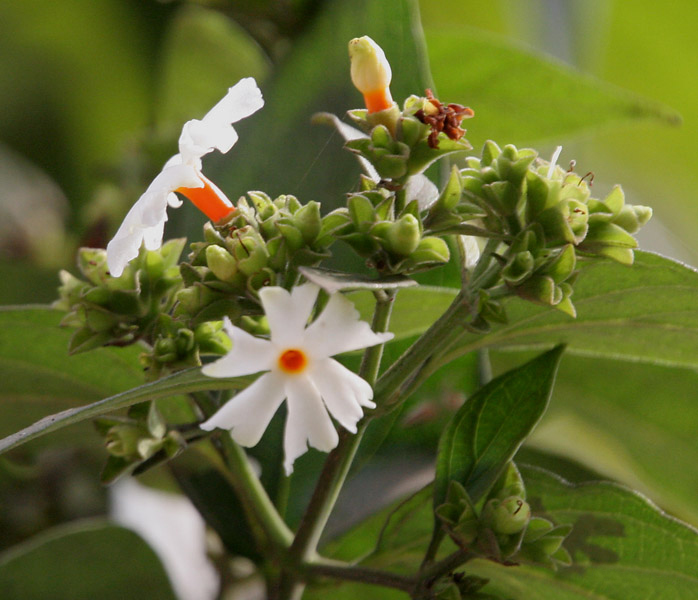
Nyctanthes arbor-tristis- (Night-flowering Jasmine) Cutting

The 'Shiuli' flowers (Night jasmine flower) mark the arrival of Autumn and Goddess Durga, the most revered goddess in Bengal. 

 These autumn flowers have a mild fragrance and are white in colour with an orange stalk, which blooms in the months of September and October.


The flowers would bloom in the wee hours of the dawn, spread their heady fragrance and intoxicates all around.

The flowers fall from the trees as the dew drops in the early morning and flower lovers pick them up and generally place them in flat bowls to keep their rooms nicely fragranced.
. . .