Showing posts with label landmarks. Show all posts

Saturday, November 6, 2010

New Market


New Market is Kolkata's oldest and most well known market. Built by the British in 1874 and started off as the Sir Stuart Hogg Market, It's still often fondly referred to as Hogg's Market. In its early days, New Market had a distinctly upper class British air about it, but it's well and truly evolved into something completely Indian. It can be crowded and chaotic, and your best bargaining skills are a must.

New Market is renowned for the variety of goods it has on offer. Shoppers are treated to over 2000 stalls selling everything from clothing to cheese with the stalls grouped according to the type of goods they sell. Although New Market is only open until 8pm, after the stalls have closed the surrounding area comes alive under the glow of lights with people eating, drinking tea and chatting. It's well worth hanging around to soak up the atmosphere.

. . .

Sunday, December 6, 2009

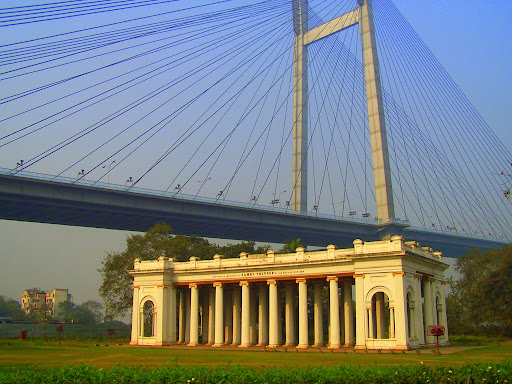
Princep Ghat


The Princep Ghat was built in the everlasting memory of James Princep, a researcher and past Secretary of the Asiatic Society here. The Ghat was opened to public in the year 1843 and is one of Kolkata's oldest recreation spot. In its initial years, all the royal British entourages used the Princep Ghat jetty for embarkation/disembarkation.

Tourists can spend hours together sitting on the benches and watching the uncluttered Kolkata life pass by gently. On the distant horizon, the magnificent Howrah Bridge and the the awesome Vidyasagar Setu makes for a kaleidoscopic vignette hanging on the large stretch of the beautiful Hooghly river with an occasional glimpse of a boatmen singing songs of the river.

. . .

Wednesday, July 22, 2009

Science City Kolkata

India - Kolkata 2 - 02 - Science City

Science City, located on Calcutta's Eastern Metropolitan Bye Pass, is an area of knowledge and adventure. This 21st Century marvel of science, communication and environment is the first and only institution of its kind in India and has a Space Theatre.


The Science Park, an astounding creation hogs the attention of the people because of its sylvan surroundings. Inside are trees and lawns with abundant scope to learn and discover in the open air.

The main attraction of the Science City is the Space Flight, Dinosaurs Alive, Dynamotion, Time Machine, Life in Water, a world of Insects and Reptiles, walkthrough Aviary, Butterfly corner, Convention Centre, four seminar halls, Mini Auditorium, Musical fountain etc.


A visit to the Space Theatre is an experience that one would cherish for a long time. It generally runs shows on the animal world, or some astronomical events.

Yet another breathtaking experience is the ride on the Time Machine which sends you to a world of suspended disbelief, by generating artificial movements and sounds, while taking you on a jaunt to the ancient Egypt or the wilds of Africa.


Then, there are the almost real size versions of the dinosaurs that gnarls and sways it body parts much to the delight of the kids hanging around. A ride of the Ropeway helps to get a clear view of the Science City as well as the outer skirts of the metropolis.

Timing : 9.00 A.M. to 9.00 P.M
. . .

Monday, July 6, 2009

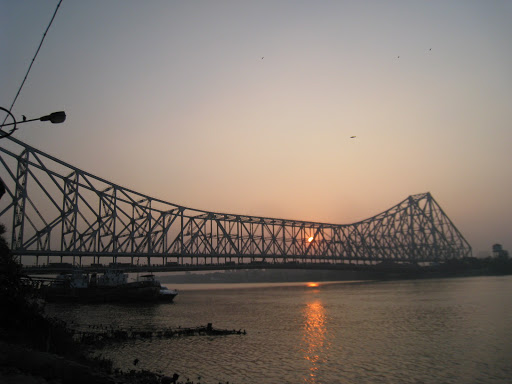
Howrah Bridge


Howrah Bridge popularly known as Rabindra Setu spanning over river Hooghly  is enumerated amongst the busiest cantilever bridges in the World. The bridge carries a traffic of around 60,000 vehicles and a lakh pedestrians everyday.

Completed in 1943, it took nearly about 7 long years to construct the Bridge . It was built by riveting the whole structure without the use of nuts or bolts. The bridge is 705 meters long and 97 feet wide. The structure of the bridge was built from 26,500 tons of high-tensile steel, supported by two piers. Each pier of the Howrah Bridge is about 90 meters above the road.
. . .

Saturday, December 6, 2008

Vidyasagar Setu


The Vidyasagar Setu, popularly known as the second Hooghly Bridge is a suspension bridge across the river Hooghly. The bridge has 9 lanes of traffic routes enabling it to handle nearly 85,000 vehicles daily. It is one of the longest bridge of its type in India and Asia.

This bridge took nearly 22 years to complete with construction starting in 1978 and finally was opened to the traffic on 10th October 1992. The Bridge is supported by 121 wire cables and is 457 meters long and 115 meters wide standing on four pylons.

Named after the great son and scholar of Bengal 'Shri Ishwar Chandra Vidyasagar', it is the third largest cable-stayed bridge of the world and is an excellent example of the sophisticated engineering marvel.


. . .

Friday, March 21, 2008

The Taj


taj mahal- place of the crown

One of the seven wonders of the world, in the heart of the city of Agra is the majestic Taj Mahal, spreading eons of charm, undwindling delight and reminiscent of pure love and dedication.


The white colour of the monument perhaps ensembles love in its purest form and its view in charming full moon nights is a ride through fairyland changing colours from the pearly pink at dawn and opalescent by moonlight. It was dedicated by mughal emperor Shahjahan in the memory of his loving wife Mumtaz, whose grave lie inside the monument. The grave lies a level below the main chamber, which contains the cenotaphs of shahjahan and mumtaz.


The taj mahal built entirely with white translucent marble and surrounded by four rounded pillars or minarets is situated in the river banks of river Yamuna. It took 22 years and 20000 workers to re-furbish this monument under the principal architecture ship of Ustad Isa, whose one of his fingers were chopped so that he cannot re-create a masterpiece again, like the taj.


Masons, craftsmen, sculptors, and calligraphers were brought from Persia, the Ottoman Empire, and Europe to work on this masterpiece. It was listed as a UNESCO World Heritage Site in 1983.


There is a small water body in front of the taj, the source of which is the river yamuna. It is surrounded by beautiful pine trees and a magnificent garden. The taj stands on a raised, square platform with its four corners truncated, forming an unequal octagon. It has a dome in the centre of it.


The entire mausoleum is decorated with the design of flowers and calligraphy using precious gems and stones such as agate, jasper, jade, crystal, turquoise, sapphire and carnelian, gives a captivating charm to its beauty. The interior of the building is dimly lit through pierced marble lattices and contains a beautiful display of carved marble.


The taj mahal has been invaded many times and has lost quite some shine due to this. It is believed that the cenotaph of mumtaz was covered by a blanket of embedded pearls in it, which is no longer there, as also many other precious items and jewels inside and outside of the monument.

In the words of poet Rabindranath Tagore ‘Let the splendor of the diamond, pearl and ruby vanish like the magic shimmer of the rainbow. Only let this one teardrop, the Taj Mahal, glisten spotlessly bright on the cheek of time...’


Inspired by dedication and shaped to perfection, the Taj Mahal immortalizes love and the splendor of an era.


NB: There seems to be a little controversy under whom this building was originally built with historical records  not giving any conclusive evidence relating to the same and diverse opinions coming out relating to the structure of the building. It is widely believed this structure was built somewhere in the 11th century with Shah Jahan re-designing it in the memory of Mumtaz.


Travellers Info:

To visit Tajmahal, you need to go to Agra in Uttar Pradesh. You can also visit directly from Delhi which is about 200 kms from Agra and takes around 5 hours.

By Air: The fastest way of reaching Taj Mahal, Agra is by air. Agra, has its own airport with major airlines operating flights to Agra on a daily basis. Or you can come to Delhi which is well connected from anywhere in India and the world and then take another flight to Agra by a domestic airline or hire a Cab/ Jeep to Agra or travel by train.

By Rail: There is a good network of trains connecting Agra with the rest of the country. Apart from the main railway station of Agra Cantonment, there are other two stations also, that of Raja-ki-Mundi and Agra Fort. For a bit more of luxurious train journey, from Delhi you can board the Palace on Wheels, Shatabdi, Rajdhani, and Taj Express.

By Road: There are regular bus services from Agra to a number of important cities. The main bus stand of Idgah has a number of buses running for Delhi, Jaipur, Mathura, Fatehpur-Sikri, etc.

Local Transportation: You can easily get taxi, tempo, auto-rickshaw in the city that will take you to the Taj. Prepaid taxis are also available if you want to visit the various places near the city. For the adventurous kind, there are bicycles that can be hired on hourly basis from different parts of the city. Since diesel and petrol vehicle are not permitted in the vicinity of Taj Mahal area, you can find battery-operated buses, horse-driven tongas, rickshaws and other pollution-free vehicles there.  
. . .

Thursday, February 21, 2008

Eden Gardens: Mecca of Cricket


The name Eden Gardens needs no introduction. This Mecca of world cricket is Kolkata's pride. The magnificent Cricket stadium is awesome in size and on any given day can accommodate spectators in excess of 100,000 making it one of the biggest cricket stadiums in the world.

It also happens to be one of the most technologically advanced cricket stadiums, complete with a state-of-the-art electronic scoreboard, a fabulous pavilion and gigantic floodlit towers which emit million watts rays during day-night cricket matches.


Cricket in Eden Gardens can be such a thrilling experience. The vast crowds and their passion for the game is what strikes the most every time you watch a cricket series here. The atmosphere is electric and packed grounds make it an unforgettable moment if you happen to be achieving a feat. Every cricketer has a dream of someday playing at the hallowed turf of Eden Gardens. It is the ultimate ecstasy for a cricketer.

Eden Gardens is the oldest cricket ground in India and is also considered one of the finest in the world. The present Eden Gardens Cricket Club came in existence some time in the year 1864. It has been called the Lord's of Asia. The stadium is the one of the largest cricketing facilities in the world, along with the MCG.


The gardens were created in 1840 and named after the sister of Lord Auckland, the former governor general. The idea was to make a Biblical - style Garden of Eden in India. The expanse dotted with beautiful trees and shrubs is intersected by winding paths, and there is a large artificial lake. Alongside the gardens, is the world famous Eden Gardens cricket stadium.


Along with the MCG, the Eden Gardens remains cricket's answer to the Coliseum. The first ever first-class match to be played here was in 1917-18, while the first Test match was against Douglas Jardine's MCC in January 1934.

Since then the ground has hosted the most number of matches than any other venue in India and it has become something of a place of pilgrimage for most international cricketers, a chance to strut their stuff in front of the most passionate and vocal crowd in the game. In February 1987, the stadium hosted its first One day international match against Pakistan.


Many grounds in India resemble each other in terms of conditions and pitches, outfields and appearances, but there is nothing quite likes the Eden Gardens. When the stands are packed with what usually is a partisan crowd, the stands come alive like nowhere else.

The sheer volume of noise generated - and this is not merely when the crowd is chanting together - ensures that the crowd imposes itself on the proceedings out in the middle. It's not merely a question of players being unable to hear each other, but the atmosphere can be plain intimidating for the visiting side.


In any International cricket game here, first comes the wave- 100000 Indians leaping to their feet, raising their arms to the heavens and shouting in unison. And in day-nighters the shower of fire-crackers and flares in the stands and on the fields in the middle of the game or more precisely throughout the entire game just electrifies the entire atmosphere.

Tens of thousands of euphoric spectators chanting ‘In-dya! In-dya!’ rolling up newspapers, setting them ablaze and holding them torch like above their heads lightens everyone spectators euphoric cheering hearts.

Eden Garden has a history of its own. The crowd can be sometimes fanatic but also be respectful to those who deserve. The same Gardens' crowd warmed up to the appeal of Tony Greig. As the huge frame of Greig went down on its knees and folded hands, the gesture moved each and every one present.


When Asif Iqbal walked back to the pavilion after a freak runout dismissal, the crowd to a man realized that he was walking out of Test cricket for ever. The huge gathering rose as one. None initially clapped. Not a sound was heard. Some had glassy eyes, others softly cleared their throats. As the despondent figure receded, a thunderous applause went up that shook the coliseum to its foundations. Eden Gardens went into raptures when Steve Waugh gestured to the umpires that while taking the catch his heel had touched the boundary rope.


If you wanna catch the buzz and the electrifying atmosphere of Eden Gardens, just be there when there is an International Cricket match on. The thrill of Eden will make you spellbound - the surging crowds, the passionate slogans, the perfectly synchronized Mexican waves and the proverbial boooo! every time a wicket falls, are all trademark Eden Gardens nuances.

The picturesque environs of Eden Gardens, reminiscent of English cricket grounds 30 years ago, blends marvelously with the mellow December sun that heralds a typical Calcutta winter morning. Not too long ago the pall of mist over the lazy Hooghly River had an ally in the swaying palms and towering poplars and pines which playfully hissed around with the breeze to create the gloomy haunt of swing and swerve.


Eden Gardens has an exclusiveness of its own. Ethereal and elusive the enduring charm of Eden Gardens has lent an aura of its own on cricketers past and present, young and old, competitive and friendly. Endearing and enchanting, the emerald green carpet and the earnest crowd have held tough men in flannels spellbound. The magic of Eden Gardens is enshrined in its purity.

. . .

Thursday, December 6, 2007

Victoria Memorial Hall


Victoria Memorial, one of the famous and beautiful monuments of Kolkata was built between 1906 and 1921 in memory of Queen Victoria. This huge white-marble museum is made from Makrana marbles from Rajasthan.  The forms in the museum like the great dome, clustered with four subsidiary, octagonal domed chattris, the high portals, the terrace and the domed corner towers speak of a splendid richness in architecture. The Memorial is situated on 64 acres of land with the building covering 338 ft by 228 ft.

The Prince of Wales, King George V, laid the foundation stone on January 4, 1906 and it was formally opened to the public in 1921. Sir William Emerson, President of the British Institute of Architects, designed and planned the building and the construction work was done by Messrs. Martin & Co.

This grandiloquent structure presently houses a museum with a large collection of oil paintings and water colours by famous European artists like Charles D'oyly, Johann Zoffany, William Hadges, William Simpson, Tilly Kettle, Thomas Hickey, Bultzar Solvyns, Thomas Hickey, Emily Eden and others. Besides these, the Memorial also houses the largest collection in the world of the paintings by the Daniells. The Royal Gallery is a storehouse of oil paintings of Queen Victoria receiving the sacrament at her coronation in the Westminster Abbey in June 1838; her marriage with Prince Albert (1840), the christening of the Prince of Wales, the marriage of the Prince of Wales (Edward VII) with Princess Alexandra and others.

The Memorial's grandeur at a height of 200 feet (184 ft up to the base of the figure of Victory, which is again 16 ft high) is accentuated by the serenity that engulfs you in its corridors. The groups of figures above the north porch represent Motherhood, Prudence and Learning. Surrounding the main dome are figures of Art, Architecture, Justice, Charity etc.

The vastness and splendour of Victoria Memorial can be comprehended from the fact that it has been divided into different divisions like the garden, library and others for maintenance and also houses a host of valuable articles like the dagger of Tipu Sultan, a cannon used in the battle of Plassey, rare books that date back to 1870, valuable manuscripts like the Ain-i-Akbari by Abul Fazal, rare postage stamps and Western paintings to entice the visitors to this awesome monument.
. . .